
MiroFish
An AI simulation chat tool for scenario prediction and analysis.
0
About
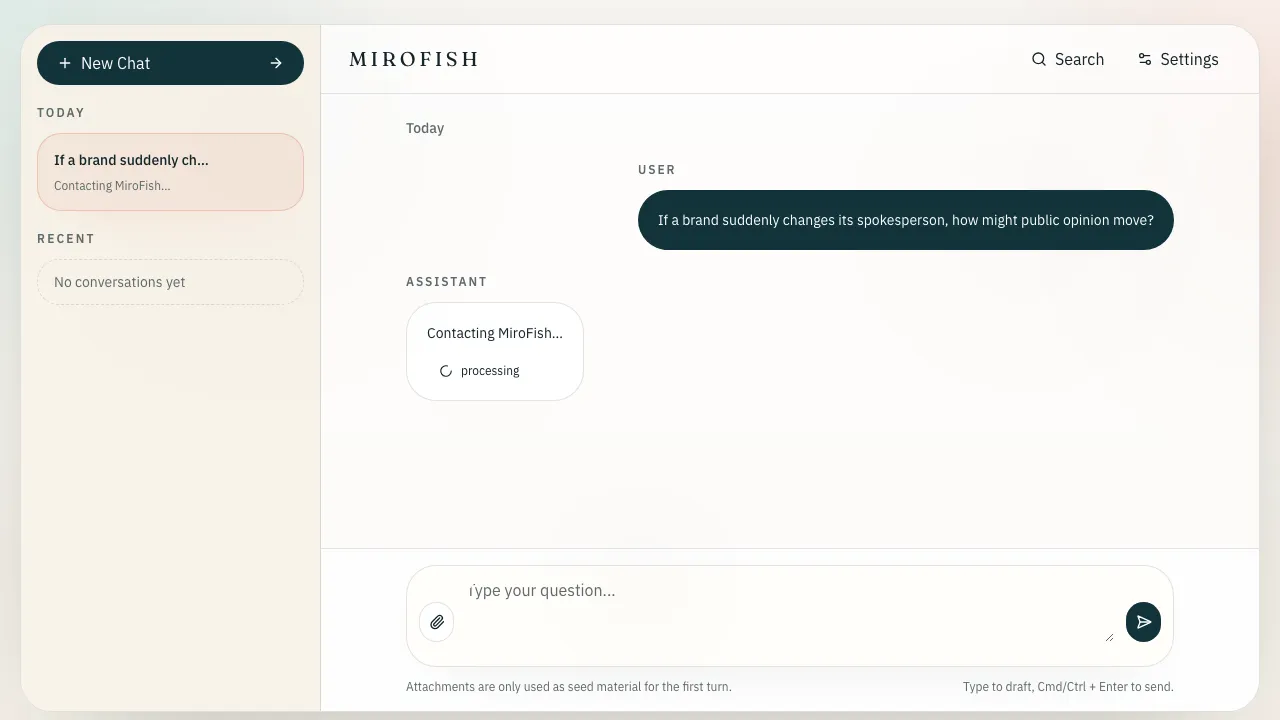
MiroFish is an AI simulation chat tool designed for scenario prediction, allowing users to ask questions and receive continuous predictions based on various factors. It is particularly useful for marketers, policy makers, and business strategists who need to understand potential outcomes of their decisions. By simulating audience reactions and narrative paths, MiroFish helps users navigate complex scenarios and make informed decisions. The tool integrates a structured workflow that combines question-asking with simulation and reporting, making it a powerful resource for planning and forecasting. Users can explore how different variables might affect public sentiment and narrative spread, providing insights that traditional forecasting methods may overlook.
Use cases
- Pressure-test a launch narrative before it goes public.
- Model customer sentiment and objections before a price increase.
- Simulate reactions to policy changes and public debates.
- Analyze market narratives and their impact on public discourse.
- Explore audience dynamics in crisis response scenarios.
Features
- 1 - AI simulation chat
- 2 - Continuous prediction workflow
- 3 - Scenario modeling
- 4 - Structured result cards
- 5 - Multi-agent interaction
FAQ
What kind of scenario is a good fit?
Use cases with human reaction loops: launches, pricing changes, policy debates, market narratives, crisis response, and creative continuation.
Do I need to upload files?
No. You can start with text, then add files when you want the simulation grounded in a specific report, brief, or source document.
What does the report include?
A useful report should summarize the likely trajectory, key actors, risk signals, evidence lines, and next questions to ask.
Is this a guaranteed forecast?
No. Treat it as exploratory decision support: a way to rehearse plausible reactions before using judgment, analytics, and real-world validation.
Loading reviews...
Related Tools

FinConv
FreemiumNo ratings yet
0 reviews
FinConv is an online bank statement converter that allows users to upload bank statement PDFs, JPGs, or PNGs and convert them into clean, structured...

BankStatement-Wizard
FreemiumNo ratings yet
0 reviews
BankStatement-Wizard is an online tool designed to convert PDF bank statements into Excel or CSV formats. It allows users to extract transaction tables...

Online Asphalt Calculator
FreemiumNo ratings yet
0 reviews
The Online Asphalt Calculator is a free tool designed to help users estimate the amount of hot-mix asphalt needed for various projects, such as driveways...

Odysseus AI
FreemiumNo ratings yet
0 reviews
Odysseus AI is a private AI workspace designed for deep research and autonomous agent workflows. It allows users to run structured research tasks in a...

MLB Review
FreemiumNo ratings yet
0 reviews
MLB Review is a comprehensive tool designed for fans and players of MLB The Show, providing real-time card rankings, market prices, and official roster...

GA Lite
FreemiumNo ratings yet
0 reviews
GA Lite is a multi-site analytics dashboard that integrates Google Analytics, Search Console, and Bing Webmaster into one platform. It allows users to...

Wondershare Recoverit
FreemiumNo ratings yet
0 reviews
Wondershare Recoverit is a powerful data recovery tool designed to help users recover lost or deleted files from various devices. It supports recovery...

Wondershare Dr.Fone
FreemiumNo ratings yet
0 reviews
Wondershare Dr.Fone is an all-in-one toolkit designed to manage, repair, and recover data from mobile devices. It offers solutions for data recovery,...

Coginiti
FreemiumNo ratings yet
0 reviews
Coginiti is an AI-powered analytics advisor designed to simplify SQL development for data professionals of all skill levels. It accelerates the creation...

Formula Generator App
FreemiumNo ratings yet
0 reviews
The Formula Generator App simplifies the process of creating complex Excel and Google Sheets formulas using AI technology. It is designed for users who...

Deepnote
FreemiumNo ratings yet
0 reviews
Deepnote is an innovative platform designed for data scientists and analysts, providing a collaborative environment for data exploration and analysis....

Formula Bot
FreemiumNo ratings yet
0 reviews
Formula Bot is an AI-powered data analytics tool that allows users to connect their data sources and generate insights, charts, and presentations in...